In brief — the direct answer
Fetal growth restriction (FGR) means a fetus is not achieving its growth potential. Placental dysfunction is common, but fetal or genetic conditions and infection can also contribute. Small-for-gestational-age (SGA) describes size, usually below the 10th centile, and includes both healthy small fetuses and those with FGR. Assessment combines size, growth trajectory, Doppler, fluid, gestation and maternal health.
What is Fetal Growth Restriction (FGR)?
SGA is not a synonym for a healthy small baby. A fetus below the 10th centile needs assessment; very small size or concerning Doppler increases suspicion of FGR. Conversely, a slowing trajectory can matter above the 10th centile. Definitions differ between guidelines, so the clinical criteria should be documented. Early FGR is generally identified before 32 weeks and late FGR at or after 32 weeks.
The growth chart and dating method affect the centile. Use the department-approved standard consistently and record its name. RCOG updated its guidance in July 2026 after NHS England stopped using INTERGROWTH estimated-weight charts because of concerns about their performance in the NHS population. This is not a worldwide prohibition: chart choice in the UAE needs local governance and assessment of population applicability. Do not switch charts simply to obtain a more reassuring centile.
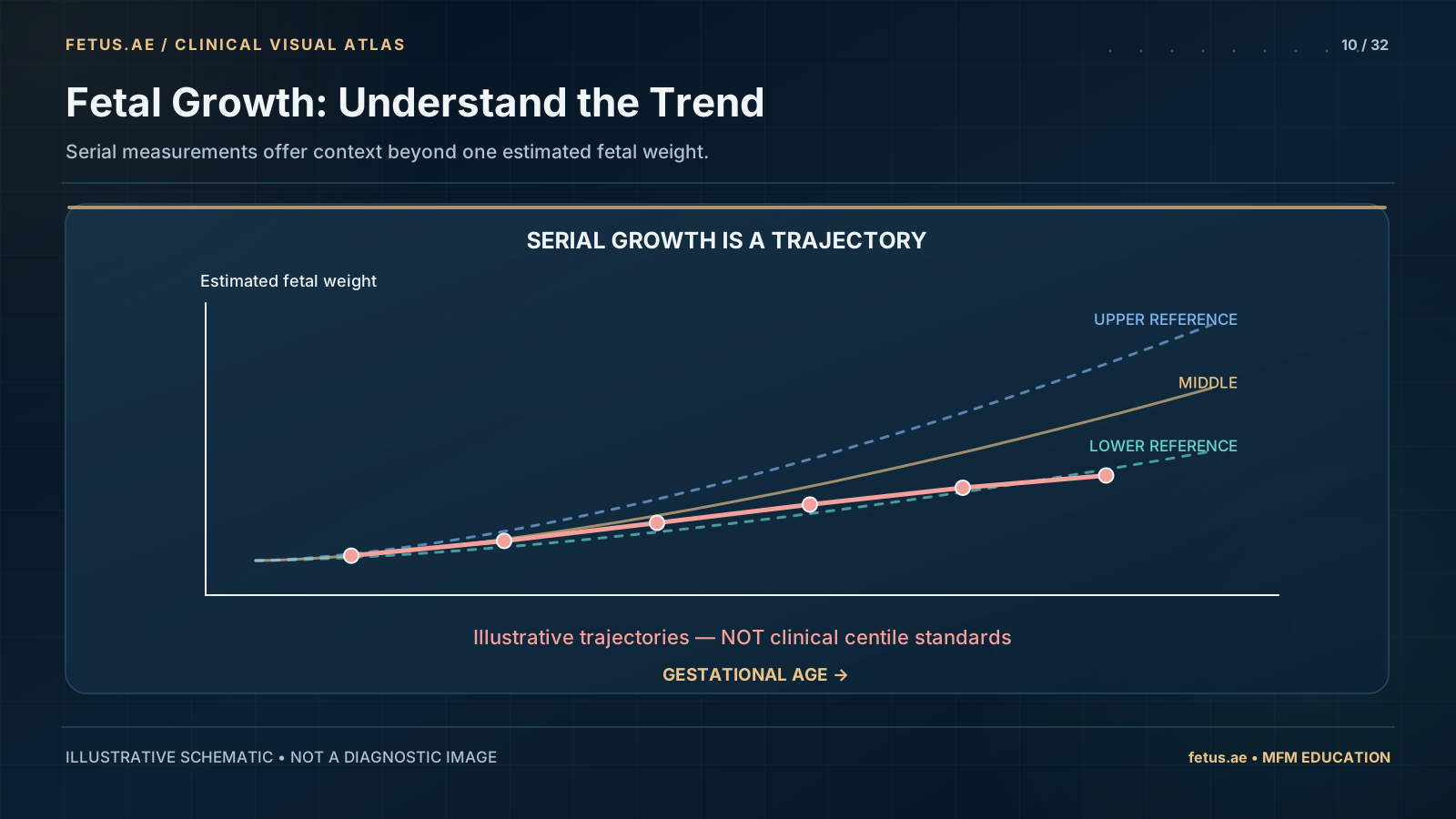 Enlarge schematic
Serial measurements offer context beyond one estimated fetal weight.
Simplified educational schematic; not to scale or for diagnosis.
Who is at risk?
Factors that increase the risk of FGR include:
- Maternal Conditions: High blood pressure (Hypertension), pre-eclampsia, kidney disease, or autoimmune disorders.
- Lifestyle: Smoking or poor nutrition can significantly impact placental development.
- Placental Issues: Abnormal development of the placental blood vessels (often caught early by Uterine Artery Doppler screening).
- Infections or Genetics: In some cases, FGR can be caused by a fetal infection (like CMV) or a chromosomal variation.
How we diagnose it
Confirm dating and measurement quality, review anatomy and serial measurements, and assess the umbilical artery Doppler and amniotic fluid. Selected cases need further Doppler, heart-rate monitoring or genetic/infection investigation. MCA, cerebroplacental ratio and ductus venosus have different roles in different guidelines and gestations; no single value determines every delivery decision.
What does management involve?
There is no established medicine that reverses placental FGR. Plan surveillance and delivery according to gestation, severity, Doppler, fetal heart-rate findings and maternal condition. Absent or reversed umbilical artery end-diastolic flow warrants urgent specialist management; it does not mean every pregnancy must be delivered immediately regardless of gestation and other findings. Corticosteroids and magnesium sulphate may be appropriate when early birth is anticipated, according to eligibility and timing. Do not start aspirin, anticoagulants or activity restriction as a self-treatment.
What are the outcomes?
Risks include stillbirth, preterm birth and neonatal complications, with substantial variation between cases. Surveillance supports timely decisions but cannot eliminate these risks. Discuss the expected neonatal course, whether placental examination is useful, infant growth and developmental follow-up, and future pregnancy planning.
When to see a subspecialist
Arrange prompt specialist review for suspected FGR, especially early or severe smallness or abnormal Doppler. Seek urgent maternity assessment for reduced movements, severe headache, visual symptoms, upper abdominal pain or feeling acutely unwell. Keep a written surveillance and delivery plan with a contact route.
Questions to ask your doctor
References & Clinical Guidelines
- Practice Guidelines: ultrasound assessment of fetal biometry and growth
- Practice Guidelines: diagnosis and management of SGA and fetal growth restriction
- Consult Series #52: Diagnosis and management of fetal growth restriction
- Green-top Guideline No. 31: investigation and care of a small fetus — includes July 2026 correction
- July 2026 growth-guideline update following NHS England’s INTERGROWTH decision
- Low-Dose Aspirin Use During Pregnancy: indications and evidence limits