In brief — the direct answer
Twin-to-Twin Transfusion Syndrome (TTTS) is a significant life-threatening complication that occurs exclusively in monochorionic (MC) twin pregnancies—identical twins who share a single placenta. In TTTS, microscopic blood vessel connections (anastomoses) on the placental surface create an uneven exchange of blood. One twin (the donor) continuously pumps blood to the other (the recipient), resulting in a dangerous fluid imbalance and cardiovascular stress. While untreated TTTS carries a high risk of fetal loss, modern fetal surgery has transformed this into a highly treatable condition.
Surface Connections: The Biology of TTTS
In a healthy shared placenta, blood flows symmetrically between twins. In TTTS, abnormal 'unidirectional' flow develops through vascular channels.
- The Donor Twin: Becomes progressively dehydrated and produces minimal urine. This leads to a severe lack of amniotic fluid (oligohydramnios), often causing the twin to appear 'stuck' against the uterine wall. The donor may also experience growth restriction and anemia.
- The Recipient Twin: Receives an excessive volume of blood, leading to a chronically overloaded circulatory system. They produce massive amounts of urine (polyhydramnios), which distends the uterus. The recipient's heart must work significantly harder to pump the extra fluid, often leading to cardiac enlargement and potential heart failure.
at the MFM Unit, we manage TTTS using the Quintero Staging System, which allows us to categorize the disease from Stage I (fluid mismatch) to Stage IV (fetal heart failure).
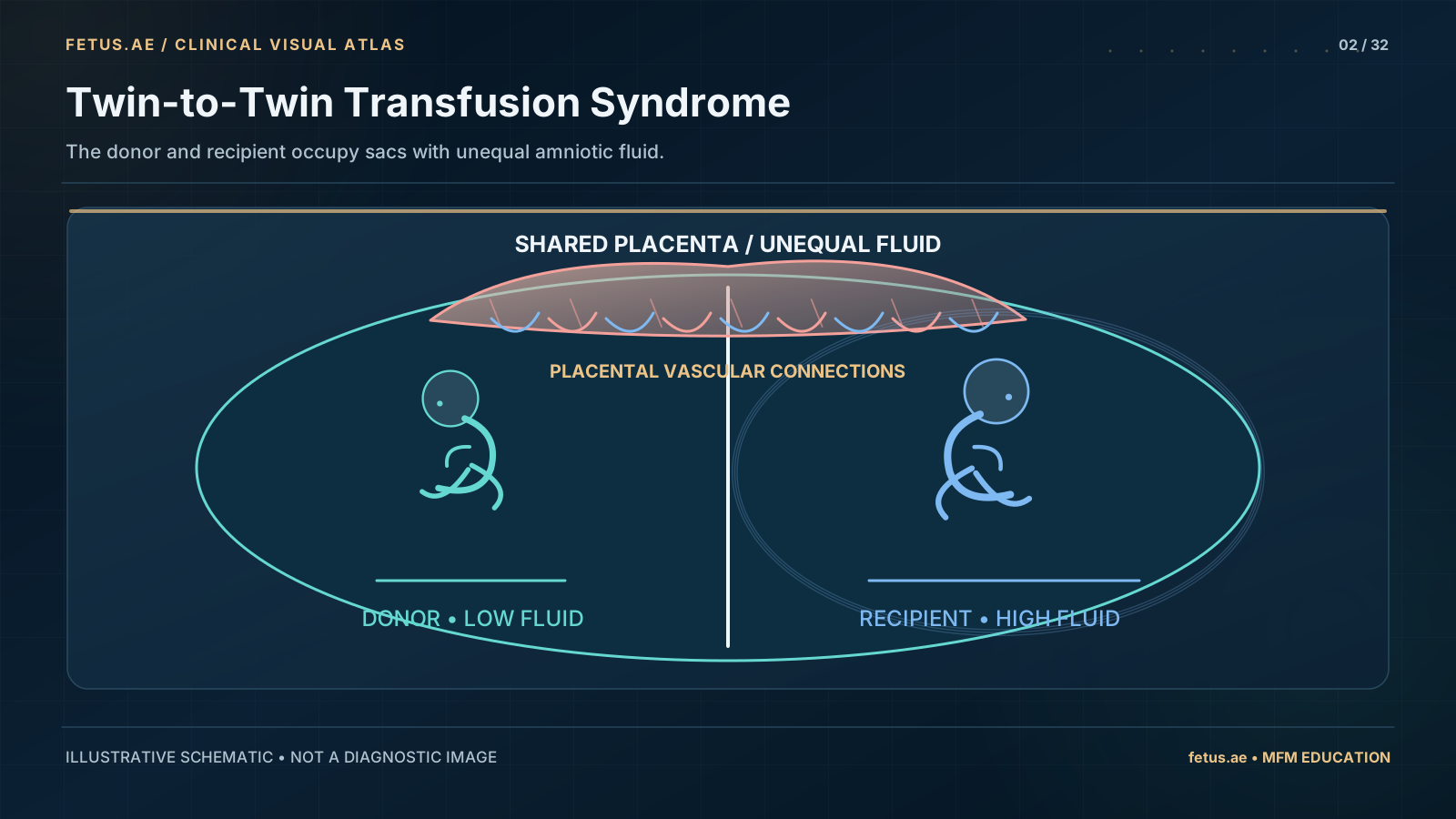 Enlarge schematic
The donor and recipient occupy sacs with unequal amniotic fluid.
Simplified educational schematic; not to scale or for diagnosis.
The Monochorionic Risk: Who is Affected?
TTTS is a risk factor only for monochorionic (MC) twins. It does not occur in fraternal (dichorionic) twins who have separate placentas.
- The Critical Window: TTTS most commonly develops between 16 and 24 weeks of gestation, though it can occur later.
- Prevalence: Approximately 10-15% of all MC twin pregnancies will develop TTTS.
- The Importance of Frequency: Because TTTS can progress from a mild fluid difference to heart failure within days, international guidelines (and our Unit's protocol) require MC twins to be scanned every 2 weeks starting from 16 weeks. Missing even one of these fortnightly scans can delay life-saving intervention.
Diagnostic Criteria: Staging Fluid and Blood Flow
Diagnosis is established through specific ultrasound findings that indicate a 'Polyhydramnios-Oligohydramnios Sequence' (TOPS):
- Fluid Mismatch: The recipient must have a Maximum Vertical Pocket (MVP) of fluid >8cm (before 20 weeks) or >10cm (after 20 weeks), while the donor must have an MVP <2cm.
- Bladder Visibility (Stage II): As the condition worsens, we can no longer visualize the donor's bladder because they have ceased urine production to protect their own circulation.
- Doppler Abnormalities (Stage III): We use advanced Doppler to measure flow in the umbilical cord and the ductus venosus. Abnormal 'reversed flow' indicates that the twins' hearts are struggling.
- Hydrops (Stage IV): The final stage before fetal loss, where the recipient shows visible fluid accumulation around the heart or lungs (heart failure).
Our subspecialists utilize high-definition imaging to detect these staging markers with high precision, guiding the decision for surgery.
Surgical Intervention: The Power of Fetoscopic Laser
The definitive, gold-standard treatment for Stage II-IV TTTS is Fetoscopic Laser Ablation (FLA).
At the MFM Unit, we utilize a minimally invasive approach:
- The Procedure: A tiny camera (fetoscope) is inserted into the womb. Guided by the screen, our surgeons identify all connecting blood vessels on the placental surface.
- The Solomon Technique: We don't just zap individual vessels; we use the 'Solomon Technique'—drawing a continuous laser line across the placenta to ensure all microscopic connections are sealed. This effectively 'divides' the shared placenta into two separate organs.
- Amnioreduction: At the end of the surgery, the excess fluid is drained from the recipient's sac to return the uterus to a normal size and reduce the risk of preterm labor.
Reviving Survival: Success Rates and Quality of Life
Outcome varies with stage, gestation, associated findings and response to treatment. Fetoscopic laser is established treatment for stage II–IV TTTS presenting at 16–26 weeks; stage I and presentations outside that window need individual assessment. Published survival estimates must not be represented as this unit’s audited results. Risks include membrane rupture, preterm birth, loss of one or both twins, recurrent TTTS, TAPS and neurological injury. Continued follow-up is essential even after technically successful surgery.
Critical Triage: When Hours Matter in Twin Care
Suspected TTTS requires prompt assessment by a fetal-therapy centre. Bring the chorionicity report, fluid measurements, bladder findings and Doppler results if available. Referral should not wait for a later stage. Sudden abdominal enlargement, breathlessness, pain, contractions or reduced movements needs urgent maternity assessment.